
The wealthiest families in Asia are in a position to fund Asia’s energy transition
For decades, Asia’s family businesses built and preserved fortunes that played a central role in the region’s growth. Now, as they dominate its economies, their choices will decide whether Asia can decarbonize at the pace the world needs.
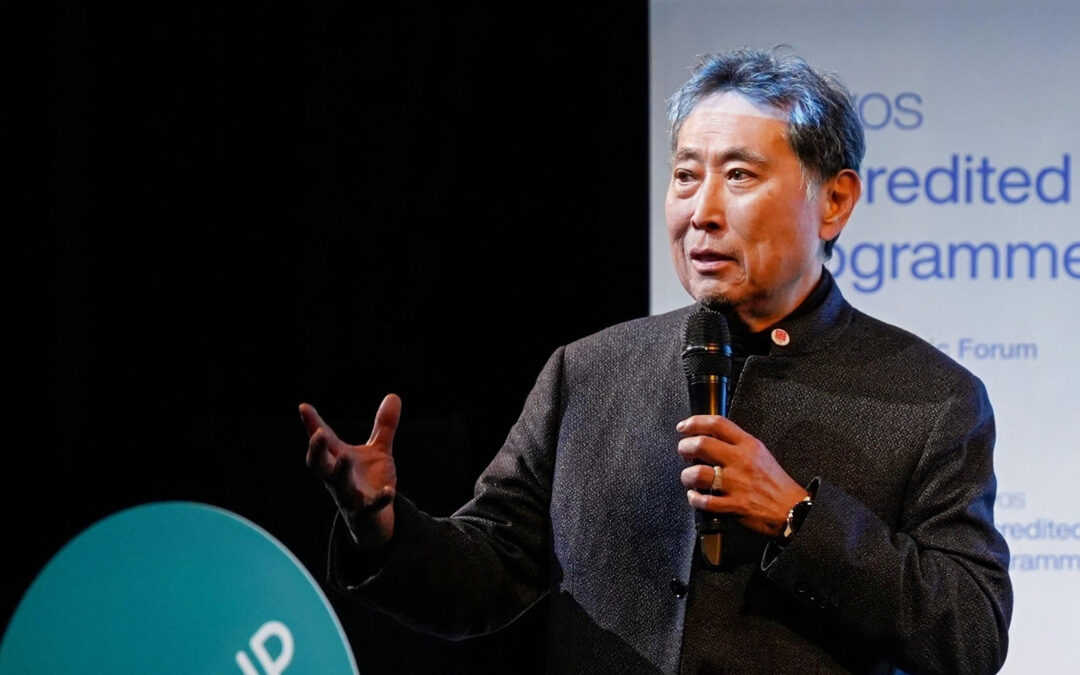
Family-owned businesses, ranging from tens of millions of small enterprises to a few hundred dominant conglomerates, generate up to 70% of Asia’s GDP and employ 60% of its workforce. The launch of IMPACT Week, led by Chavalit Frederick Tsao (affectionally known as “Chairman Fred”) of Tsao Pao Chee (TPC), represents an opportunity for the region’s conglomerates to shift their focus from simply amassing wealth to financing Asia’s energy transition.
Family-owned businesses generate up to 70% of Asia’s GDP and employ 60% of its workforce
The inaugural IMPACT Week in Singapore in September marked a first step toward bringing some of these vast private fortunes into the partnerships and frameworks needed to drive Asia’s low-carbon transition.
The shipping heir who wants to redefine Asian capitalism
Fred Tsao is a fourth-generation shipping magnate turned impact investor who took over the helm of his family’s business in 1995. While TPC’s valuation and the full extent of the Tsao family’s wealth are not publicly disclosed, its maritime and industrial logistics operations, long the core of the Singapore-based family office, suggest significant scale. In 2024, the company reported it employed more than 8,000 people across 15 countries.
In Davos this January, Chairman Fred Tsao explained to me why he had rebranded the century-old family empire. For decades, the Tsao family business operated as IMC — International Maritime Carriers — contributing to Asia’s industrial boom with a footprint that stretched from Japan and China to Hong Kong, Thailand, Malaysia, Singapore, and Indonesia. But in 2024, Tsao restored its original name, TPC (Tsao Pao Chee), founded by his great-grandfather in 1906, which, he says, draws on traditional Chinese beliefs in harmony and prosperity.
Tsao says the firm’s goal now is to “serve the well-being of life” by generating impact and commercial returns across the entire organization’s footprint. Of course, TPC’s use of the term “well-being” is intentionally broad. In Fred Tsao’s own writings, he defines it as a model that creates value for people and the planet, aligning capital with the flourishing of all life. Some critics might note that this can all sound diffuse or hard to measure, stretching from personal wellness to entire economic systems. Still, climate action remains a core and explicit part of Tsao’s agenda. As he often notes, if nature is destroyed, there is no value (economic or otherwise) to preserve — and for him, that is precisely why any steward of generational family wealth must care about sustainability if it hopes to endure.
This shift is more than a branding exercise for TPC. Tsao aims to set an example for others by transforming TPC’s structure to embody his “well-being” philosophy. Tsao himself often points out that shipping is one of the world’s most carbon-intensive industries, responsible for 2% of global energy-related CO₂ emissions, according to the International Energy Agency. To that end, TPC has begun shifting capital in its portfolio towards “impactful ventures,” such as sustainable food supply chains, corporate philanthropy (including its foundation wing, NO. 17 Foundation), and greener solutions for its own shipping operations. In 2024, it was reported that the firm had launched two venture funds that have jointly already invested US$320 million in “impact and well-being” initiatives, including startups focused on environmental sustainability and social impact. A practical example, Tsao says, is the adoption of more sustainable methods to scrap old ships as they are replaced by modern, green vessels.
For Tsao, however, changing his own business is only part of the plan. “This journey is not one that I can walk alone,” he told me in that first meeting in Davos. “We need other business leaders and what I call consciousness capital to embrace a well-being mandate, introducing new models into industrial supply chains to restore nature.”
[I]n some markets, such as Hong Kong, the top 15 families account for more than 80% of GDP.
The scale of family capital, and why It matters
The rationale for Tsao’s broader ambition, and why it matters for Asia’s future, could not be clearer. New data from Preqin, a London-based investment firm owned by BlackRock, shows that one in four family offices worldwide are now based in the Asia Pacific region, with Singapore and Hong Kong leading the way. While the United States is home to many powerful family offices, such as Walton Enterprises (Walmart) and Cascade Investment (owned by Bill Gates), family-owned firms in Asia dominate entire swaths of the economy on a far more proportionally significant scale. These conglomerates, now in their third or fourth generation, contribute between 60% and 80% of national GDP across Asia, and in some markets, such as Hong Kong, the top 15 families account for more than 80% of GDP. This concentration of economic power, rooted in decades of state-led industrialization, weak early capital markets, and deep cultural traditions of intergenerational stewardship, gives giants such as India’s Tata Group and South Korea’s Samsung outsized influence. Even a modest shift of their capital could have far-reaching effects across Asia and beyond.
This concentration of economic power… gives giants such as India’s Tata Group and South Korea’s Samsung outsized influence.
“Because we’re private, we can move faster than publicly listed companies; the family makes decisions,” Tsao told me. He noted that if his peers, who control multisector conglomerates or billion-dollar family offices, adopted his same mindset, Asia’s low-carbon transition would not only be possible but would set off a ripple effect worldwide.
It could, for example, significantly reduce Asia’s carbon footprint, create new business opportunities in the sustainable energy sector, and improve the region’s global competitiveness. After all, the region accounts for more than half of global emissions and underpins supply chains, from manufacturing to the extraction of critical minerals. If its stewards of family wealth lead, they can create the demand necessary for others to follow — especially at a moment when many listed companies (and countries!) have grown more risk-averse on decarbonizing their value chains.
If its stewards of family wealth lead, they can create the demand necessary for others to follow — especially at a moment when many listed companies (and countries!) have grown more risk-averse on decarbonizing their value chains.
For example, following South Korea’s Samsung Group’s commitment to achieve net-zero operations by 2050, a pledge backed by $5 billion in investment, all of its manufacturing sites in the United States, Europe, and China are now powered by 100% renewable electricity.
IMPACT Week and the making of a new climate finance hub
The question, of course, is how to get more of Asia’s businesses to follow TPC’s lead. Despite a recent surge in Asian companies setting comprehensive climate targets, they have historically moved more slowly than their Western counterparts. When it comes to impact investing, much of Asia still lags the United States and Europe by a decade or more in terms of institutional development, scale, and market infrastructure. A 2024 Deloitte report on Asia-Pacific family offices found that while 52% of Asia-Pacific family offices engage in “sustainable investing,” this compares with roughly 76% in Europe and 63% in North America that invest in clean energy. Those hesitant about embracing impact investing in Asia most often cited barriers, such as “not knowing enough about it” (47%) and “an insufficient pool of appealing investments or concerns over market immaturity” (37%).
To change this dynamic, Tsao launched IMPACT Week in Singapore last month, a forum designed to build confidence and address perceived risk and unfamiliarity. The event brought together more than 3,000 participants across family offices, policymakers, innovators, startups, foundations, investors, leading non-profit organizations, major banks and financial institutions, the World Economic Forum, and boutique venture funds. Unlike the often-fragmented nature of Climate Week in New York, IMPACT Week was centralized yet flexible, leaving space for funders to connect directly with entrepreneurs.
When it comes to impact investing, much of Asia still lags the United States and Europe by a decade or more in terms of institutional development, scale, and market infrastructure.
And while much of Tsao’s holistic “well-being” philosophy infused the event’s messaging, the presentations from entrepreneurs — especially those in the “Igloo” domes that hosted so-called “learning lab” sessions — offered plenty of proof points showing why investment in climate and sustainability initiatives can deliver strong returns. As Tsao himself often says, “No money, no honey.”
In that sense, he remains a clear-eyed businessman who understands what it takes to shift capital at scale, which helps explain why the event attracted the likes of Temasek, Singapore’s massive state-owned investment firm. One example of a project on display during IMPACT Week was announced by organizers as Asia’s largest Ocean Fund, aiming to raise $75 million to fill a critical gap in early-stage blue-economy financing across the region.
To be clear, Tsao does not believe private wealth alone can save the world, and he is mindful that no actor operates in isolation from policy or geopolitics. Part of the rationale for hosting IMPACT Week in Singapore was the city-state’s position as both an accessible and relatively neutral financial hub, with a government willing to experiment with aspects of Tsao’s vision: using policy to incentivize the deployment of private capital.
As a case in point, and in a form of policy entrepreneurship, or what political economist Steven Vogel calls “marketcraft,” Singapore announced, on the eve of IMPACT Week, plans to purchase 2.2 million tons of high-quality nature-based carbon credits from Peru, Paraguay, and Ghana, including one of the world’s first large-scale soil-carbon schemes. Together with new guidance allowing companies to offset up to 5% of their taxable emissions through international credits, Singapore is attempting to build demand for carbon markets that tackle deforestation while generating new financing for the energy transition.
Globally, as politics casts a shadow over other financial hubs, the private sector is reacting to the collective signal emanating from Singapore.
Globally, as politics casts a shadow over other financial hubs, the private sector is reacting to the collective signal emanating from Singapore. IMPACT Week drew delegations from Africa, Europe, and the United States, many of which sought capital for nature-based and clean-energy projects that such credit sales can help fund. For some participants, such as South Africa’s Harith General Partners and Pele Energy Group, it was their first time seeking to engage capital in Asia to scale energy access across Africa.
Shifting the epicenter of transition financing to Asia
While no single actor can drive the transition alone — and few public details yet suggest a torrent of family-owned firms following TPC’s example — IMPACT Week is nonetheless the latest sign that the center of gravity for climate action may be shifting toward Asia. A reorientation of family-owned businesses toward green impact investing would certainly mirror other regional developments: from China’s booming clean-tech exports to Indonesia’s revised phaseout commitments on coal.
At the close of IMPACT Week, Chairman Tsao unveiled an AI-generated video inspired by his book Impact Investing for Life Flourishing. The short film envisioned a world in balance — where renewable energy meets future consumption needs, technology works in harmony with nature, and prosperity aligns with well-being and happiness. It was both a creative flourish and a call to action, illustrating the future Tsao believes Asia’s private capital can help build. An impressive vision — if his peers follow his lead.
Disclosure: TPC’s philanthropic arm, the No. 17 Foundation, provided a grant to Global Citizen — the advocacy organization where the author works — to support delegates, speakers, and cultural programming at IMPACT Week. This article was written independently, and the views expressed are those solely of the author.