
Households and businesses rush to solar-plus-storage, showing how bottom-up energy transitions can reshape emerging economies
This article was originally published on Climate and Capital Media.
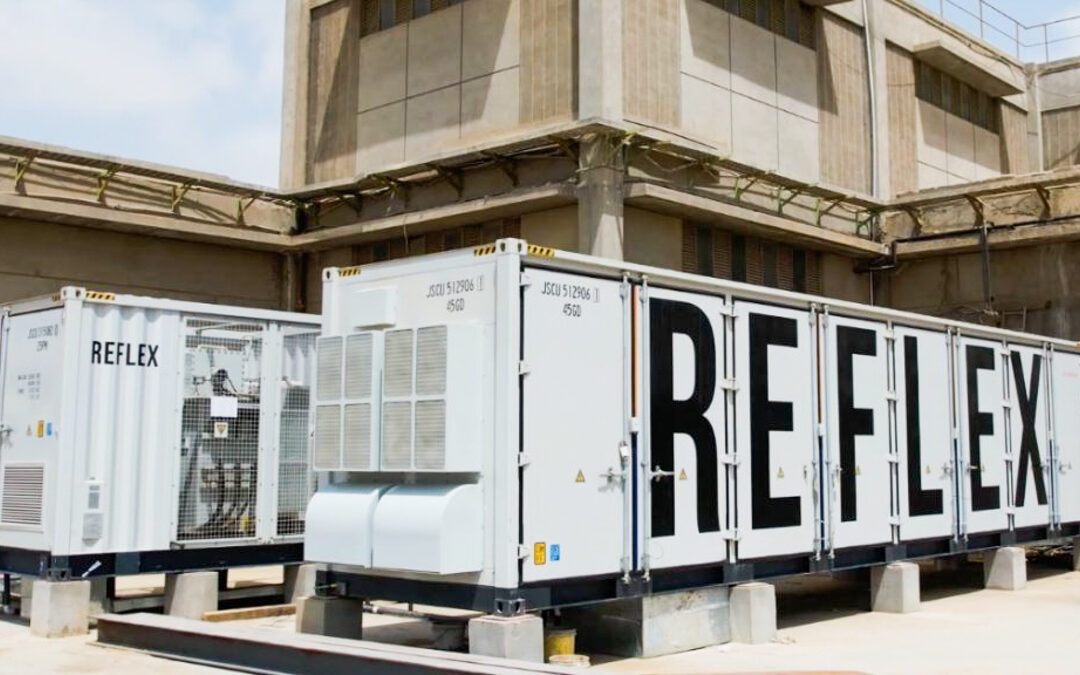
At a cement plant in Pakistan’s northwestern Khyber Pakhtunkhwa province, the country’s largest battery is about to come online. This battery is designed to stabilize the plant’s energy needs, but its capacity is equivalent to keeping tens of thousands of homes lit through a grid outage. It comes alongside a record surge in solar installations as households, farmers, and businesses cover their roofs with panels and add batteries to survive rolling outages and rising bills. Together, these industrial and consumer investments signal a bottom-up transition that makes Pakistan a window into the future of energy, especially in emerging economies confronting similar pressures.
Why Pakistan’s battery boom is happening now
In less than two years, Pakistan has become the world’s sixth-largest importer of solar panels. Now, that import bonanza is spilling over into batteries. The country imported about 1.25 gigawatt-hours (GWh) of storage in 2024 and another 0.4 GWh by February 2025, according to a report by the Institute for Energy Economics and Financial Analysis (IEEFA). Together, based on typical household demand, those 1.65 GWh are roughly enough stored energy to power about 600,000 homes for an evening.
To be sure, the figures remain modest compared to bigger markets. Saudi Arabia is expected to surpass 11 GWh of utility-scale storage by 2025, while Europe added a record 21.9 GWh in 2024 alone. But Pakistan’s numbers are striking not because of size, but because they are being driven by a combination of everyday users and private industry rather than top-down public investment.
“This is being driven at the individual level…like the water system, where people no longer rely on piped supply, households and businesses are taking energy into their own hands,” says Professor James Trevelyan, an engineer and inventor of Coolzy air-conditioning technology who has studied Pakistan’s power system for decades (and installed his own solar panels in-country). In other words, like solar before it, most battery imports have gone to factories, farms, and households striving for self-reliance after years of blackouts, worsening grid quality, and volatile prices.
[L]ike solar before it, most battery imports have gone to factories, farms, and households striving for self-reliance after years of blackouts, worsening grid quality, and volatile prices.
But high electricity prices alone don’t fully explain the solar‑and‑battery boom. The trend has been fueled by a flood of low‑cost solar and battery imports from China — 17 GW of solar panels alone arrived in 2024 — while Pakistan’s net‑metering policy (which lets households sell excess solar back to the grid) has made payback periods for small installations a mere 2–4 years.
“Cheaper solar … [has also] increased the appetite for solar‑plus‑batteries,” says Ibrahim Dajani of the World Bank’s Pakistan office.
Risks to the grid and Pakistan’s poor
Solar-plus-batteries are already lowering energy bills and improving reliability. They are also helping ease pressure on Pakistan’s strained grid (while lessening reliance on imported fossil fuels like LNG) — especially during hot months when air-conditioning demand soars. In fact, Pakistan’s grid demand dropped in 2024 — even as the economy grew. But the World Bank’s Dajani warns that this storage growth must be managed rigorously, or “it will risk destabilizing the grid.”
The first risk is financial. Fewer people and businesses buying grid power does not change the fixed payments utilities still owe to private power producers under long-term contracts, locked in regardless of electricity use. These costs will get pushed onto a shrinking pool of paying customers, worsening Pakistan’s chronic “circular debt” — billions in unpaid bills passed between utilities, the government, and producers. And those left holding the bag will very likely be the least able to afford it. “If everyone leaves the grid, those left behind will end up paying more — and in many cases, these are the poorer families who cannot afford to buy panels and batteries,” says investor and strategist Taufiq Rahim.
The surge in solar and batteries has made households, farms, and factories more self-reliant, but it has also exposed the limits of Pakistan’s grid and policy framework.
The second risk is technical. Pakistan’s grid was designed for one-way power flows, not for thousands of homes and businesses feeding power back into the system. As adoption spreads, risks like “reverse power flows” and voltage fluctuations increase. Without urgent policy reform, a report by Pakistani-based think tank Renewables First warns that “the advent of batteries may effectively condemn the grid to obscurity.” That scenario would again leave behind those who cannot afford to take energy into their own hands.
The choice ahead
The surge in solar and batteries has made households, farms, and factories more self-reliant, but it has also exposed the limits of Pakistan’s grid and policy framework. “Pakistan’s always had an electricity problem,” says investor Rahim. “The question now is whether battery and solar growth can be centralized as well, so it’s not just private backup but something that strengthens the grid as a whole.”
The choice for governments is whether to rally behind this people-powered movement — to accelerate it and ensure it does not leave the poorest behind with heavier power bills.
Analysts from the World Economic Forum, along with IEEFA and Renewables First, all point to three immediate priorities to help ensure that mass solar and battery adoption strengthens the grid rather than strain it.
- Pay battery owners for grid services. Create rules that enable owners to earn payments for their contributions to grid stability during spiking demand.
- Target subsidies fairly. As it stands, wealthier households with solar benefit more from energy subsidies than poorer ones. Providing support, through concessional loans or low-cost financing through philanthropy or institutions like the World Bank, would allow the poorest to pay less to participate in this distributed revolution, making the transition fairer.
- Let batteries join the market. Instead of working in isolation, households and firms with storage should be able to sell or share their power through Pakistan’s new trading system (CTBCM).
Whether these reforms happen quickly enough is another question. Travelyon is skeptical: “You’re not going to see coherent government policy or action dramatically change the situation. That ship has sailed,” he says. Yet he remains optimistic that as solar and battery costs keep falling, adoption will spread until even poorer households can take part — using storage much like the rooftop water tanks that are already a fixture of daily life, filling them when supply is available and drawing on it when it isn’t. As he put it: “The positives outweigh the negatives… People will keep driving the transition themselves.”
Lessons for other regions
Pakistan is not alone in its bottom-up adoption of solar-plus-storage, driven by volatile grid prices and the availability of cheap imports.
Across Africa, solar imports rose 60% in the year to June 2025, with at least 20 countries setting new records. Not all of this growth is strictly consumer-led: in Egypt, for example, Trina Storage recently completed a 300 MWh battery in Aswan — the country’s first integrated solar-and-storage facility, large enough to power roughly 100,000 homes for an evening. In Nigeria Genesis Energy has equipped Katsina state’s largest hospital with solar PV and batteries, cutting millions in diesel costs and ensuring uninterrupted healthcare. But much like in Pakistan, the broader trend across the continent is still being driven by households, farmers, and small businesses taking energy into their own hands.
This consumer-led revolution will spread, propelled by economics, scalability, and its distributed nature. Gone are the days when securing energy meant relying only on massive, centralized power plants. The choice for governments is whether to rally behind this people-powered movement — to accelerate it and ensure it does not leave the poorest behind with heavier power bills. But the revolution itself will not be stopped.